
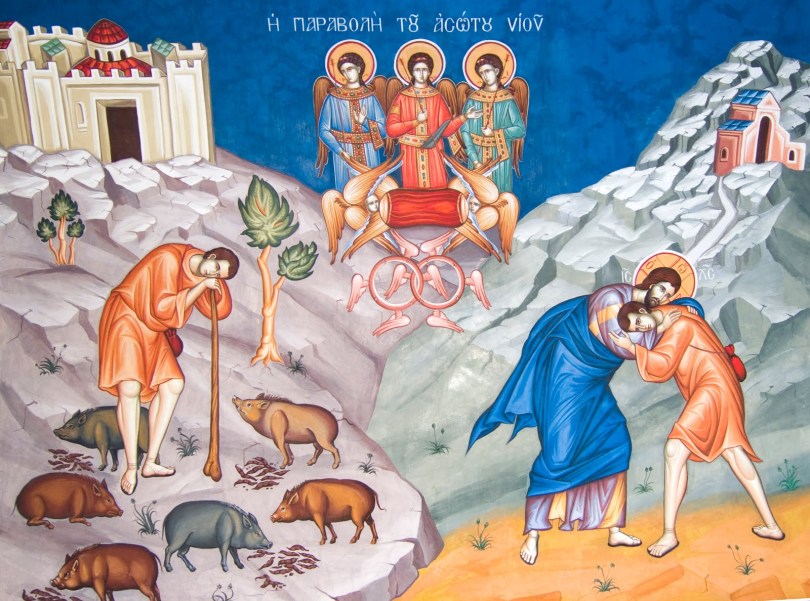
Prodigal, Come Home

You are a new creation, He has made you brand new. You are who He says you are. And to Him you are beloved, you are precious, you are holy, you are righteous, you are blameless, you are enough. You don’t need to do anything to gain approval from Abba. He approved of you from the foundation of the world. You are the apple of His eye. You are the child He always wanted. You are beautiful, compassionate, tender-hearted, faithful, and kind. You are all these things because He made you so. He made you to be like Him, in His image and likeness. He declared that you are very good from the beginning. He is well pleased with you.

The Father is well pleased with you, and requires nothing of you but to rest in His love. You could never write another word, you could not give another penny, you could never keep another feast day, and He would love you just the same. He loves you, not because of the things you do or don’t do, but because He loves. Love does not live at the expense of others. Love is not self-serving. This is the premise from which we must read everything from Scripture, especially the words of Jesus. Jesus came to show us the Father’s love.

The Father much like the father in the prodigal son parable has been misunderstood. The Father of fathers, the best one of all, has been rejected by His sons. They have not seen His goodness, His unconditional love, His mercy, His generosity. Humanity has either gone away from Him and lived a hedonistic lifestyle or we’ve placed burdens on ourselves that He never required of us–seeing ourselves as no better than servants, when He has always loved us and seen us as sons. “My son you have always been with me and all I have is yours.”

This is a Father who loves and does not pick favorites. He has never withheld anything from the eldest son; the eldest son never considered himself worthy enough to ask. Do you see? It’s not how God perceives us, it’s how we’ve perceived ourselves–that was the dysfunction we got from Adam, a dysfunction that Jesus came to correct.

You are to die for! You are worth laying down His own life in order to show you the extent of His love. He has placed no other burden, no command but to Shema! Hear with your heart all the love He has for you; believe and be transformed in the renewing of your mind by this truth that He has said about you! Then you will be free to love as you have been loved–not the love that expects love in return, but love for its own sake.
Cain and Abel: Personal Growth v. Violence

It is a tale as old as time–the struggle between two ways of living in the world, and it is illustrated for us in the story of Cain and Abel in the Bible.

“In the course of time Cain brought an offering to the Lord from the fruit of the ground, while Abel, for his part, brought the fatty portion of the firstlings of his flock. The Lord looked with favor on Abel and his offering, but on Cain and his offering he did not look with favor. So Cain was very angry and dejected. Then the Lord said to Cain: Why are you angry? Why are you dejected? If you act rightly, you will be accepted; but if not, sin lies in wait at the door: its urge is for you, yet you can rule over it.”

Genesis 4:3-7

In 1940, George Orwell wroote a book review of Mein Kampf. The following is from the last paragraph:

And [Hitler] has grasped the falsity of the hedonistic attitude to life. Nearly all western thought since the last war, certainly all “progressive” thought, has assumed tacitly that human beings desire nothing beyond ease, security and avoidance of pain. In such a view of life there is no room, for instance, for patriotism and the military virtues. The Socialist who finds his children playing with soldiers is usually upset, but he is never able to think of a substitute for the tin soldiers; tin pacifists somehow won’t do. Hitler, because in his own joyless mind he feels it with exceptional strength, knows that human beings don’t only want comfort, safety, short working-hours, hygiene, birth-control and, in general, common sense; they also, at least intermittently, want struggle and self-sacrifice, not to mention drums, flags and loyalty-parades. However they may be as economic theories, Fascism and Nazism are psychologically far sounder than any hedonistic conception of life. The same is probably true of Stalin’s militarised version of Socialism. All three of the great dictators have enhanced their power by imposing intolerable burdens on their peoples. Whereas Socialism, and even capitalism in a more grudging way, have said to people “I offer you a good time,” Hitler has said to them “I offer you struggle, danger and death,” and as a result a whole nation flings itself at his feet.[1]

Hitler understood somehow that man has two parts. On the one hand that they want comfort, ease, and safety, and on the other, that they need to fight for and struggle toward something to find meaning.

Read any children’s book or watch any movie with a hero and you find this to be true. The hero cycles from comfort, to a desire for or even a push into adventure, climaxes with the “hero” being brought to the brink of death, and then concludes with the journey back home to comfort and safety with stories of glory to shared around the campfire or in a village pub.

Human beings keep telling these stories because they are fundamentally true. They tell them because their soul longs for meaning. But there is another part to humanity that wants to be the lord of their own lives and everything they survey.

When one focuses their attention on “cleaning their room”, one chooses to be like Abel. Through sacrifice in the short-term, one plans for the long-term, being concerned for the welfare of others and caring more about relationships than possessions. By critically examining oneself and removing the parts that are unloving, unkind, and selfish, one willingly takes on the struggle toward a more whole human being, free of vices and rich in virtues, and looking for that which is meaningful and eternal.

If one doesn’t employ the “scalpel” to oneself, one will turn it into a “sword” toward their neighbor as Cain did with his brother.  One will look at what another has and think that they somehow deserve it. If one’s mindset is that they are entitled to another man’s land, money, or wife, they will have no problem stealing, killing, and destroying their neighbor to get that which they desire. One, who makes the “other” into a sacrifice on the altar of self-importance, becomes their own god; everyone is lesser than, a thing to serve their needs and desires. Violence is hurled at the outer world and replaces the personal growth through struggle in the inner world.


[1] http://www.gutenberg.net.au/ebooks16/1600051h.html